| Region | |
|---|---|
| Subregion | France > Bordeaux > Left Bank > Pauillac |
| Colour | Red |
| Type | Still |
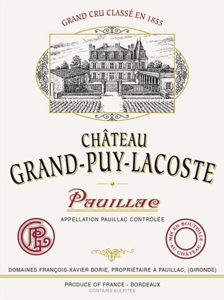

Blackberry and licorice aromas, with full body, very fine tannins and a long finish. Very silky. So much for jammy wines in 2003. Very fresh and refined. Best after 2008.
The 2003 Grand Puy Lacoste initially shows a little mustiness on the nose. It's tertiary, with gravel and vestiges of black fruit. A second bottle is much fresher and more vibrant, a success considering the vintage. White pepper and clove notes are pretty grippy, with touches of cooked meat becoming spicier towards the finish. A little untamed, which is unusual for this Pauillac, but then again, why not once in a while? Tasted at the château. 2023 - 2036
An atypically superficial effort from one of my favorite Pauillacs, the 2003 Grand-Puy-Lacoste is very good, but it does not stand up to some of the finest northern Medoc offerings. A deep ruby/purple-tinged color is followed by a moderately intense bouquet of black currants and underbrush. It hits the palate with good fruit and medium body, but tails off in the finish. It is an elegant, lighter-styled example of this generally high-class performer. It can be consumed over the next 10-12 years.
Lots of evolution at the rim. Lift and raciness. Thick and sweet and just a tad heavy - and certainly oddly sweet! (Average group score: 15.5)
Reminiscent of the 1990, this blend of 70% Cabernet Sauvignon, 26% Merlot, and 4% Cabernet Franc possesses low acidity, good ripeness (but not over-ripe), and Grand-Puy-Lacoste’s classic creme de cassis character well-displayed. Medium to full-bodied with noticeable tannin in the finish, it is a heady, rich, beautifully made Pauillac that should be drinkable within 3-4 years. Anticipated maturity: 2007-2018.
Full and rich with loads of blackberry and cherry character. Ripe tannins. Long finish. Pretty red. Almost 92-94. Very good indeed.
Respectable crimson. Light nose. Rather comforting rich fruit flavours on the front palate and some tannins on the finish – more of a conventionally structured claret than any of the St-Estèphes. Pretty chewy on the finish still. I think this may outlive the Montrose, or at least the bottle of Montrose described above.
Real delicacy. Fragrant and gentle with fine but not aggressive tannins at the end.
A very well-made fine, elegant wine with potential for development.